# AI Agents Are Coming to Indian Businesses — Here’s What to Expect in 2026
## Summary
– 24% of Indian enterprise leaders have already deployed agentic AI, and 47% of organizations now operate multiple GenAI use cases according to EY’s 2026 India C-suite survey.
– Microsoft’s deployment of 200,000+ Copilot licenses to Indian IT companies is the largest enterprise AI rollout globally, signalling that agents are moving from pilots to production.
– The Model Context Protocol (MCP), open-sourced by Anthropic, has crossed 97 million downloads and is becoming the universal connector that lets AI agents interact with business tools.
– Indian SMBs can start with agent-based automation for customer support, invoice processing, and CRM management without building anything from scratch.
—
## Beyond Chatbots: What AI Agents Actually Are
If you have been using ChatGPT or Gemini over the past couple of years, you have been interacting with AI assistants. You ask a question, you get an answer. That is useful, but it is fundamentally reactive.
AI agents are different. They plan, reason, use tools, and execute multi-step tasks with minimal human intervention.
Think of it this way: a chatbot can tell you the weather. An AI agent can check the weather, see that rain is forecast, reschedule your outdoor client meeting, send an email to the client with new venue options, and update your Google Calendar — all from a single instruction.
This shift from “answer my question” to “handle this task” is what the industry calls agentic AI. And in 2026, it has moved firmly from research demos into production deployments across Indian enterprises.
## The Numbers Behind India’s Agent Adoption
EY’s “AIdea of India 2026” report — based on a C-suite survey of 200 Indian enterprises — paints a clear picture of where things stand.
About 47% of Indian organizations now run multiple GenAI use cases. Nearly half report that over 21% of their proofs of concept have progressed to full production. And 24% of enterprise leaders say they have already deployed agentic AI systems.
These are not just the usual Bangalore tech companies. Financial services firms in Mumbai, manufacturing groups in Pune, and retail chains operating across India are all in the mix.
Gartner’s forecast adds weight to this: 40% of enterprise applications will embed task-specific agents by end of 2026, up from less than 5% in 2025. IDC projects AI spend in India growing at a 33.7% compound annual rate.
The biggest signal came from Microsoft. In January 2026, the company rolled out over 200,000 Copilot licenses to Indian IT firms — TCS, Infosys, Wipro, Cognizant — making it the largest enterprise AI deployment anywhere in the world. When the biggest companies in India’s most important industry go all-in on AI agents, the rest of the market follows.
## Understanding the MCP Protocol — The “USB-C” of AI
One of the biggest challenges with AI agents has been getting them to actually do things. A language model can draft an email, but it cannot send one unless it has access to your email system. It can recommend a database query but cannot run it without a connection to your database.
This is where the Model Context Protocol (MCP) comes in.
Created by Anthropic and open-sourced in November 2024, MCP defines a standard interface through which AI agents access external tools — API calls, database queries, file system operations, web searches, code execution, and anything else a developer exposes through an MCP server.
By early 2026, MCP had crossed 97 million downloads. Both MCP and Google’s A2A (Agent-to-Agent) protocol now sit under the Linux Foundation’s Agentic AI Foundation, launched in December 2025 with six co-founders: OpenAI, Anthropic, Google, Microsoft, AWS, and Block.
Why does this matter for Indian businesses? Because MCP drops integration time from months to weeks and can cut development costs by up to 70%. Before MCP, connecting an AI agent to your Zoho CRM required custom code. Now, you can use a standard MCP server for Zoho and the agent just works.
Think of MCP as the USB-C port for AI. Instead of needing a different cable for every device, you have one universal connector.
## Practical Use Cases for Indian SMBs
Large enterprises with dedicated AI teams can build custom agents. But what about the lakh-plus Indian SMBs that form the backbone of the economy? Here is where things get practical.
### Customer Support Automation
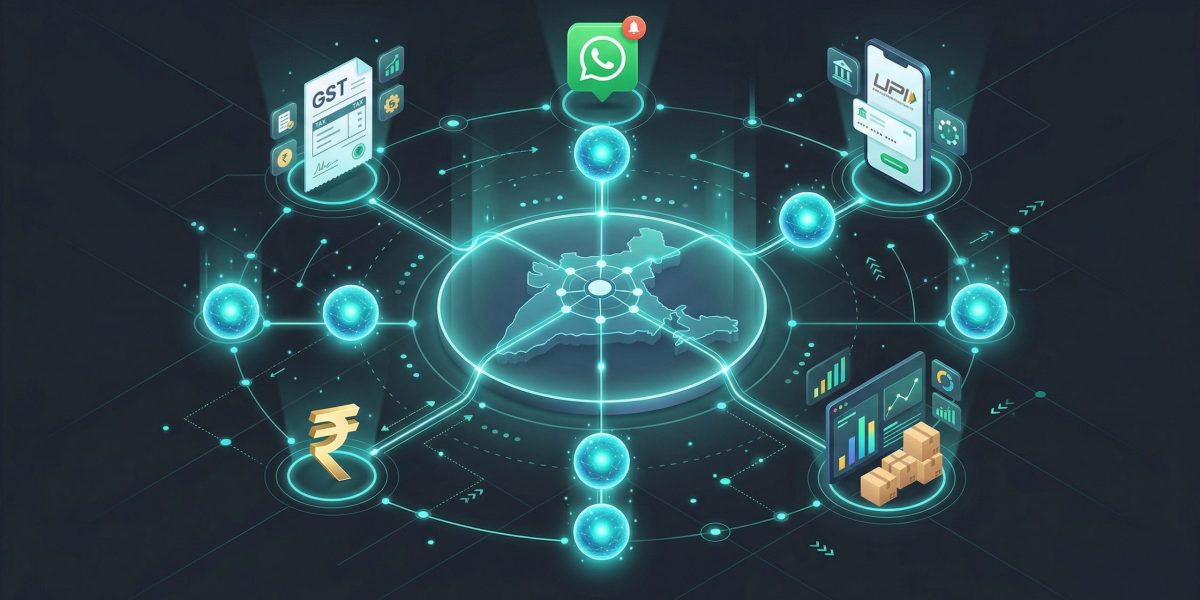
An AI agent connected to your WhatsApp Business account, CRM, and order management system can handle 60-70% of routine customer queries without human intervention. It can check order status, process simple returns, answer product questions, and escalate complex issues to your team with full context.
For an Indian e-commerce SMB processing 500 orders a day, this can reduce support team workload by half.
### Invoice and Payment Processing
Connect an AI agent to your Tally, Zoho Books, or accounting system. It can extract data from invoices (even handwritten ones using OCR), match them against purchase orders, flag discrepancies, and initiate payment processing. For businesses dealing with GST compliance, agents can automatically categorise expenses and prepare return-ready data.
### Sales and Lead Management
An agent integrated with your CRM can score incoming leads based on your historical conversion data, draft personalised follow-up emails, schedule meetings, and update pipeline status. It works around the clock — particularly valuable when you are selling to customers across different Indian time zones or to international clients.
### HR and Recruitment
For companies hiring at scale — IT services, BPOs, retail chains — AI agents can screen resumes, schedule interviews, send status updates to candidates, and even conduct preliminary assessments. This does not replace your HR team; it frees them to focus on candidate experience and strategic hiring decisions.
### Inventory and Supply Chain
An agent monitoring your inventory levels, connected to supplier APIs and demand forecasting models, can automatically generate purchase orders when stock falls below thresholds, negotiate with approved suppliers based on predefined rules, and alert you to supply chain disruptions before they hit your production line.
## The Multi-Protocol Future
MCP gives your agent hands — the ability to use tools. But what happens when you need multiple agents working together?
That is where Google’s A2A (Agent-to-Agent) protocol comes in. While MCP handles tool access, A2A enables agent coordination — your sales agent talking to your inventory agent talking to your logistics agent.
The emerging enterprise stack for 2026 looks like this:
– **MCP** for connecting agents to tools and data sources
– **A2A** for enabling agents to collaborate with each other
– **ACP/UCP** for handling commercial transactions between agent systems
Indian companies do not need to implement all of these immediately. Start with MCP for single-agent use cases and expand as your needs grow.
## What Indian SMBs Should Do Right Now
Here is a practical roadmap if you are running a business in India and want to start with AI agents without betting the company on unproven technology.
### Step 1: Identify Your Highest-Volume Repetitive Tasks
Look at where your team spends the most time on tasks that follow predictable patterns. Customer support queries, data entry, report generation, and invoice processing are common starting points.
### Step 2: Start with Ready-Made Agent Platforms
You do not need to build agents from scratch. Platforms like n8n (open-source, can be self-hosted in India for data residency), Microsoft Copilot Studio, and Salesforce Agentforce offer pre-built agent capabilities that integrate with common Indian business tools.
### Step 3: Keep Humans in the Loop
The smartest Indian companies in 2026 are using a human-in-the-loop approach. The agent handles execution, but humans retain control over high-risk decisions — approving large payments, responding to sensitive customer complaints, making hiring decisions.
### Step 4: Measure Before You Scale
Track concrete metrics: time saved per task, error rates before and after, customer satisfaction scores, cost per transaction. Only scale what demonstrably works.
### Step 5: Get Expert Help for Integration
Connecting AI agents to your existing tech stack — especially if you are running a mix of Indian platforms (Tally, Razorpay, Zoho) alongside international ones (Salesforce, AWS) — requires integration expertise. [Win Infosoft’s AI automation team](/services/ai-automation) specialises in building agent workflows that work with the tools Indian businesses actually use.
## The Governance Question
Gartner warns that over 40% of agentic AI projects could be scrapped by 2027 due to unclear ROI and governance challenges. This is not a reason to avoid agents — it is a reason to approach them thoughtfully.
Before deploying AI agents in your business, establish clear answers to these questions:
– What decisions can the agent make autonomously, and which require human approval?
– How do you audit what the agent did and why?
– What happens when the agent makes a mistake?
– How does this comply with India’s Digital Personal Data Protection Act (DPDPA)?
Companies that answer these questions upfront will be the ones whose agent projects survive and scale. Companies that skip governance for speed will be the ones contributing to Gartner’s 40% failure statistic.
## India’s Strategic Advantage
India is not just a consumer of AI agent technology — it is becoming a creator and exporter. The India AI Impact Summit 2026 showcased homegrown developments: Sarvam AI’s Vikram model, BharatGen for Indian language AI, and agentic payment integrations between Razorpay and NPCI.
With the IndiaAI Mission expanding compute capacity to 58,000 GPUs at subsidised rates, India is building the infrastructure for a domestic agent ecosystem. The country’s combination of a massive technical talent pool, sovereign AI investment, and an enormous domestic market makes it one of the most important agentic AI markets globally.
The era of AI agents in Indian business is not approaching. It is here. The question for every Indian business leader in 2026 is not whether to adopt agents, but how wisely to do so.
—
## Frequently Asked Questions
### What is agentic AI and how is it different from ChatGPT?
Agentic AI refers to AI systems that can autonomously plan, reason, use external tools, and execute multi-step tasks. Unlike ChatGPT which responds to individual prompts, an AI agent can handle complete workflows — such as checking inventory, creating a purchase order, and emailing a supplier — from a single instruction.
### What is the MCP protocol and why should Indian businesses care?
The Model Context Protocol (MCP) is an open standard that lets AI agents connect to external tools and data sources. For Indian businesses, MCP means you can connect AI agents to your Zoho, Tally, Razorpay, or any other tool using a standard interface instead of expensive custom integrations. It reduces integration costs by up to 70%.
### Can small Indian businesses afford AI agents?
Yes. Open-source platforms like n8n can be self-hosted for under Rs 1,000 per month. Microsoft Copilot and Google Workspace AI features are available at standard subscription prices. The key is starting with one high-volume repetitive task and measuring the ROI before expanding.
### Is agentic AI safe for handling business-critical tasks?
With proper governance, yes. Most Indian enterprises in 2026 use a human-in-the-loop approach where agents handle execution but humans approve high-risk decisions. Establishing clear rules about agent autonomy, audit trails, and compliance with DPDPA is essential before deployment.
—
*Ready to bring AI agents into your business? [Win Infosoft](/contact) helps Indian SMBs and enterprises implement agent workflows that integrate with your existing tools. Also read: [Impact of AI on the Indian Job Market](/blog/ai-indian-jobs) and [N8N and Open-Source Automation for Indian Startups](/blog/n8n-automation-india).*